
This audit is about what happens once you're in the room. There's an earlier stage: whether recruiters find your profile at all. About two minutes. Your first fix is free.
Check your findability→For a good chunk of my job search, I was convinced the problem was my interviewing.
That's where your head goes when you lose final rounds. You replay the answers. You rewrite the stories. You prep harder for the next one. I did all of it.
The feedback, when I got any at all, made it worse. It was never "she doesn't have the skills." It was always some version of "didn't quite prove it enough," and it was different every single time. Nothing consistent enough to act on. So I was left deriving my own conclusions from scraps, and the conclusion I kept landing on was that I just wasn't interviewing well.
That's honestly why this audit exists. Interviewers weren't going to give me a straight answer. My own data could.
My search wasn't the version most people are living, and I want to be upfront about that. I wasn't starving for interviews. I had plenty, and a lot of inbound on top of it. And it STILL took six and a half months, because the conversion grind was real the entire time. So when it ended, I did what I apparently can't stop doing with anything in my life: I put the whole thing in a spreadsheet and audited it like a funnel. Every process, where it started, how far it got, how it ended.
The interviewing was fine. My advance rate sat close to 50% at every stage, the whole way through. Steady. Which means all those months I spent re-prepping my stories, I was treating the wrong problem.
Here's what the audit actually taught me, including a few things I've never said before.
What warm intros actually did for me
Warm opportunities (inbound leads, intros through my network, people who found me) turned into real interviews about 3x more often than my cold applications did.
Once I was inside a process, though, warm and cold advanced at nearly the same rate. Close to 50% at each stage either way.
I don't think that means intros don't matter. They clearly do, they're doing their work at the front of the process, and I'd guess it plays out differently when your intro is directly to the hiring manager. Mine mostly weren't. They were an inbound lead, or a warm intro, or somebody introducing me to somebody.
So get the intros. Just know what they're buying you: the conversation. What happens after that is on you.
Same number of interviews every month. Very different results.
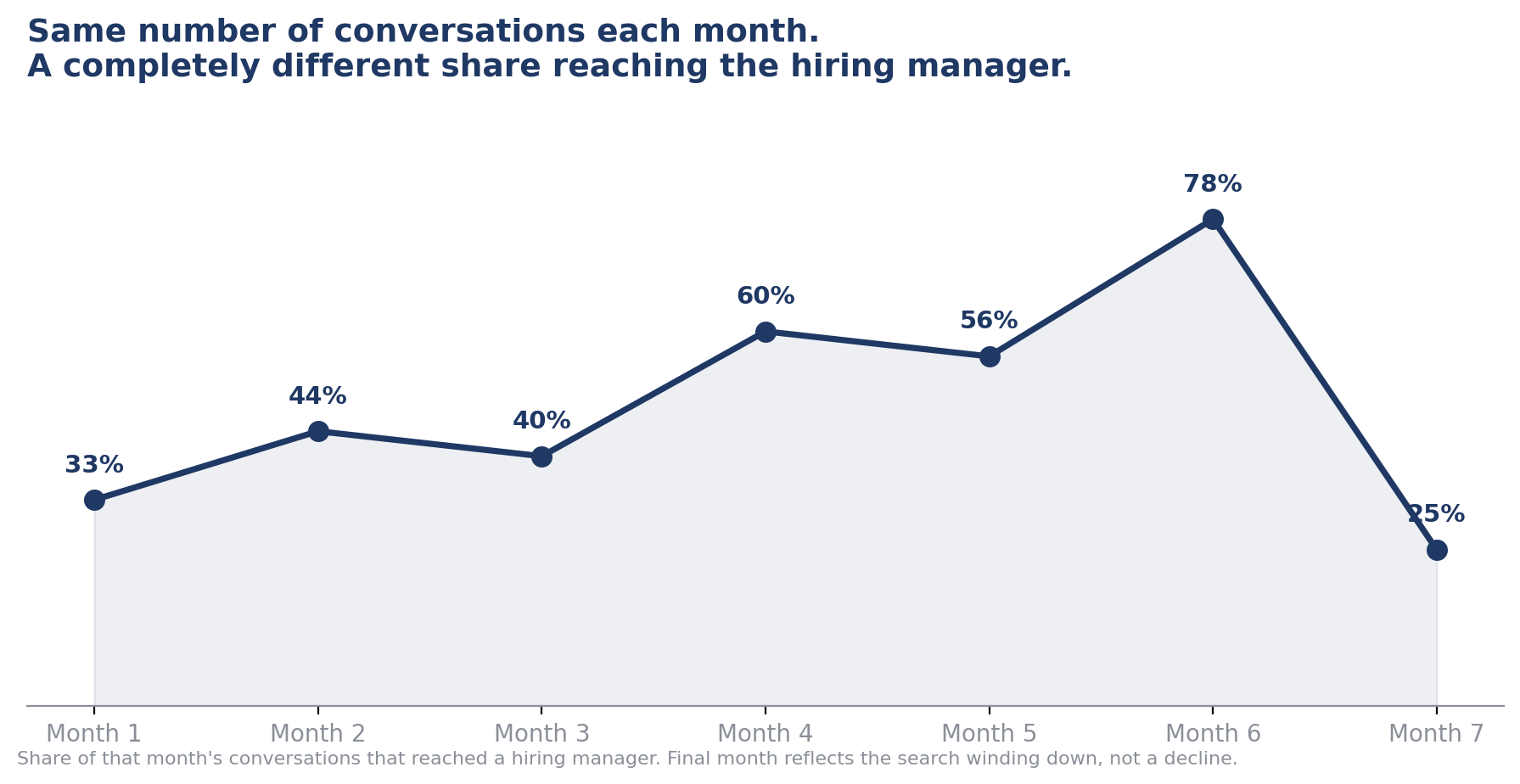
This chart is my favorite thing to come out of the audit.
My monthly interview count barely changed across the search. But early on, about a third of my interviews reached a hiring manager. By the end, it was closer to four out of five.
I wasn't working harder in month six than in month two. I promise you that.
What changed was what I let into the funnel. Early on I said yes to almost everything: cold applications to so-so fits, recruiter calls for roles that were never right. Later I was pickier about what I pursued, and more of what came to me was already right before we ever talked.
This is the same lesson I keep writing about on the marketing side of this site. When a business is struggling, the instinct is to send more email. When a search is struggling, the instinct is to apply to more jobs. Same instinct, same trap. More of a thing that isn't working just gets you more of what you already have. The fix is changing the strategy, not the volume.
I already had the answer in 2025. Then I threw it away.
Confession time.
In early 2025 I posted on LinkedIn seriously, with a real strategy behind it. Then I landed a job, and within a couple of months I drifted off.
And here's the part I only understood after analyzing my own old posts: the ones I did write while employed performed badly, and the reason is almost embarrassing. I sounded employed. Launch announcements. Team stuff. Nobody cares about your launch. Nobody cares that your team did something cool. Nobody. Ever.
So when I needed the engine again this January, I was rebuilding it from scratch, mid-search, at the worst possible time. The engagement came back immediately, and it built from there. But the part that matters, the right people knowing what I'm about and sending me real opportunities, took months to build back. Posting on LinkedIn didn't get me the job. But it was starting to get me real traction, and it changed who showed up in my inbox.
What I'd actually do differently
People ask me this, and the honest answer is that almost none of it is about the search itself.
- I would never have stopped posting. That's the big one. If I'd kept going after April 2025, this January wouldn't have been a cold start. You want to be building this invisibly, all the time, while you're employed and nothing is on fire. I've written the full case for this.
- I'd sound like a person the whole time, not an employee. My employed-era posts were company news in a trench coat, and they went nowhere. The stuff that works is what YOU think, what you'd teach someone, what you've figured out. That doesn't stop being available just because you have a job.
- I'd make myself easier to put in a box, sooner. My background never fit one clean title, and for a long time I resisted picking one. Eventually I went with healthcare marketing, consumer engagement, and said it everywhere. Was it perfect? No. I ended up landing outside the industry entirely (more on that another time). But here's the thing: your network can only help you if they can remember you for something specific. I see profiles with five industries and three role types, and I get why they do it, but nobody can send that person a lead. Pick the box. Wrong-ish and memorable beats accurate and confusing.
- I'd get discerning way earlier, on both inbound and outbound. Being pickier is what fixed my funnel, and I found it months later than I should have. I don't think it would have gotten me hired faster. But it would have given me back real time, and that time had other uses, like freelance work to stretch the runway.
- I'd cap the hours on interview projects. I put serious time into a few of them, 20 hours in one case, doing what was honestly $5,000 to $10,000 of free strategy work, throwing things at the wall trying to guess what they wanted. That's the problem with these projects: you get no feedback along the way, so they're a bit of a toss-up no matter how good you are. I'm not against them, they can show people how you think. But set a limit and don't pour hours into the deck itself. If you don't have a template or an AI tool you can just plug it into, don't hand-build one. Get a Gamma subscription, pay the $10, and let it make things look professional. The PowerPoint doesn't have to wow anyone, and it doesn't have to be in their brand. The thinking is the deliverable.
- I'd optimize my profile on day one, not month three. Recruiters search exact words. If your profile doesn't contain them, you don't exist, and nobody tells you. And I'm not trying to pitch-sell you here. Yes, I have a paid tool for this, but honestly, whatever you use, do it. Your profile, along with the posting, is worth so much more than your resume in this market. It's really, really important, and it needs to be optimized.
The market is brutal right now, and I've written plenty about that side of it. But the biggest thing my own data handed me is this: I spent months fixing my interview answers when my interviews were never the problem. Look at your own numbers before you decide what's broken. It's probably not the thing you're beating yourself up about.